
Oxidative Processes
In these processes, micropollutants are chemically transformed through the addition of an oxidizing agent. The micropollutants are oxidized, thereby losing their original properties. The aim of these processes is to chemically degrade the compounds to such an extent that they no longer exhibit harmful effects on the environment.
However, complete mineralization is often difficult to achieve. In most cases, micropollutants are only partially oxidized, forming various transformation products. In addition, other substances present in municipal wastewater effluents may also be oxidized, leading to the formation of so-called “oxidation by-products.” In order to degrade these biodegradable oxidation by-products and transformation products, post-treatment in a biologically active stage is required according to the current state of knowledge.
Oxidative treatment processes include ozonation as well as advanced oxidation processes (AOPs). Ozonation is currently the only oxidative process applied at full scale in municipal wastewater treatment plants for micropollutant removal.
AOPs, while generally capable of removing a broad spectrum of micropollutants from wastewater, have significantly higher energy requirements and therefore higher operating costs compared to ozonation. As a result, they have not yet been implemented for micropollutant removal in municipal wastewater treatment plants.
Further information and details can be found in this publication.
Ozonation
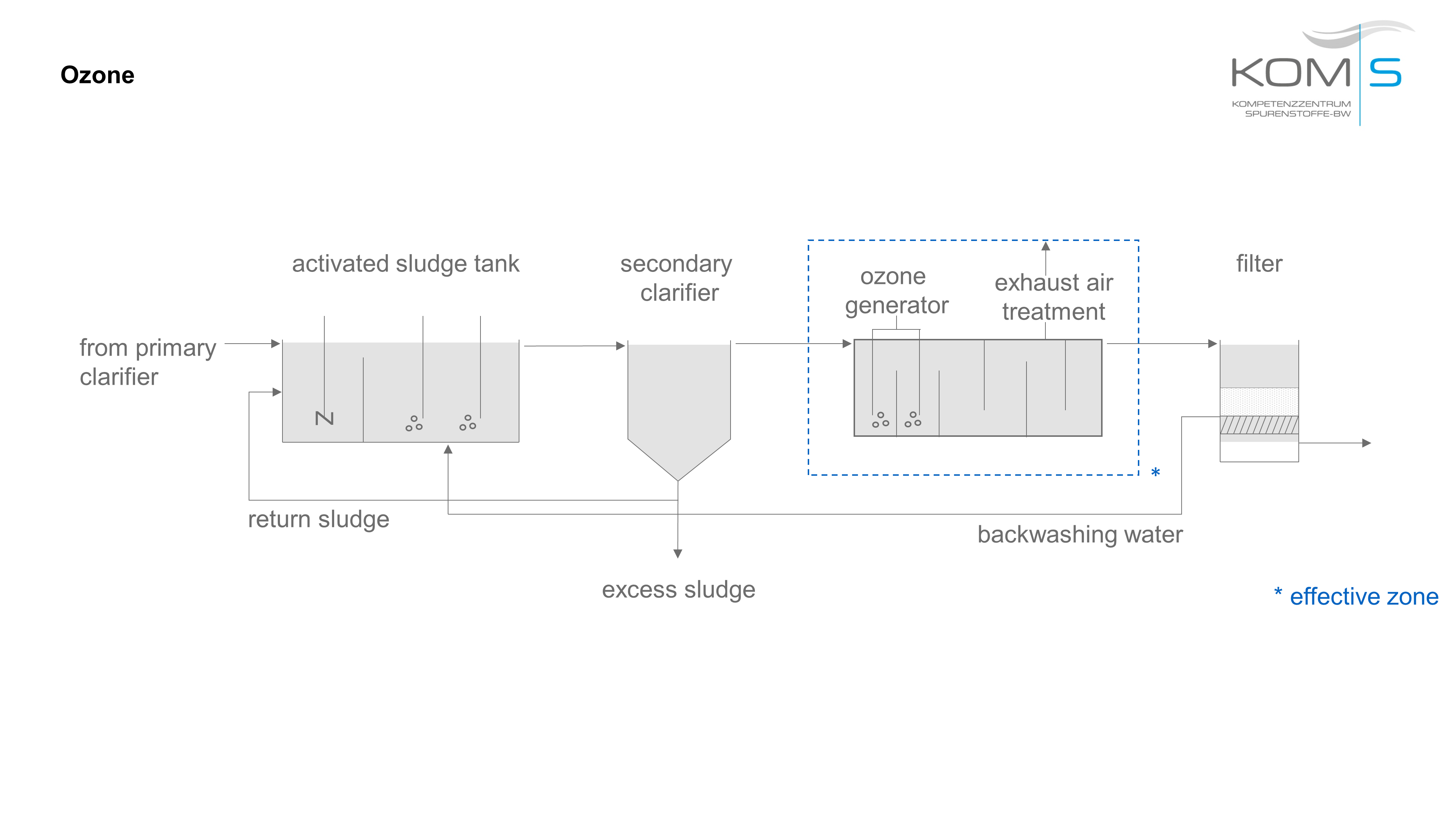
Ozone is a strong oxidizing agent that reacts in aqueous environments via two main pathways:
Selective direct reactions with water constituents that contain electron-rich bonds (e.g., amino groups, double bonds, and activated aromatic structures).
Radical chain reactions initiated by the decomposition of ozone into hydroxyl radicals, which react very rapidly and non-selectively with a wide range of water constituents.
Ozone reacts not only with target micropollutants but also with other wastewater constituents such as dissolved organic carbon (DOC), suspended solids, or nitrite. To minimize ozone consumption, ozonation is therefore preferably applied after the biological treatment stage.
For the technical implementation of ozonation in municipal wastewater treatment plants, the following components are required:
- Ozone generator: Ozone is produced on-site from oxygen or dry air using an ozone generator. Ozone production is energy-intensive and generates significant heat, requiring cooling.
- Contact reactor: In the contact reactor, ozone is introduced into the wastewater, where it reacts with micropollutants and other constituents. To achieve high removal efficiency and effective ozone utilization, sufficient residence time is required, which can be achieved, for example, by staging the reactor in a cascade configuration. The reactor must be gas-tight to prevent exposure of operating personnel to ozone.
- Off-gas treatment: This unit is used to destroy residual ozone in the reactor off-gas.
- Post-treatment: To remove oxidation by-products, a subsequent biologically active process (e.g., sand filter, maturation pond) or an activated carbon filter is recommended.
- Monitoring and control systems (MCS): for process control and automation.
Advanced Oxidation Processes
Advanced oxidation processes (AOPs) are based on the oxidation of wastewater constituents by hydroxyl radicals (•OH). These radicals are highly reactive and react very rapidly and non-selectively with a wide range of organic compounds. For application in wastewater treatment, they must be generated on-site.
The following process combinations can be used for radical formation:
- Ozonation combined with ultrasound
- Ozonation combined with hydrogen peroxide (H₂O₂)
- Ozonation combined with ultraviolet (UV) irradiation
- Ultraviolet (UV) irradiation combined with hydrogen peroxide (H₂O₂)
- Ultraviolet (UV) irradiation combined with titanium dioxide (TiO₂)
- Fenton’s reagent (Fe²⁺ and H₂O₂)
To date, no AOPs have been implemented at full scale for micropollutant removal in municipal wastewater treatment plants.