About KomS
KomS
Who we are
We support operators of municipal wastewater treatment plants in introducing, optimizing, and implementing processes for the elimination of micropollutants and promote knowledge transfer between practitioners, researchers, authorities, and associations. As Competence Centre for Micropollutant Elimination Baden-Württemberg, we are the central point of contact for information, exchange, and research on micropollutants and their impact on our waters—funded by the Ministry for the Environment, Climate and Energy Sector Baden-Württemberg.
We provide up-to-date information, advise on planning and operation through our website, events, and publications, and conduct laboratory tests and research projects.
Our mission
Wastewater treatment plants are a major pathway through which trace contaminants (also known as micropollutants) enter our rivers and lakes. Trace contaminants are substances that occur in wastewater at very low concentrations, typically ranging from micrograms per liter (µg/L) to nanograms per liter (ng/L).
To protect the environment, these substances need to be removed from wastewater. This is also a key requirement of the revised EU Urban Wastewater Treatment Directive. Our mission is twofold: first, to raise awareness and promote knowledge transfer on this topic; and second, to support the upgrading and expansion of municipal wastewater treatment plants.
History of micropollutant removal in Baden-Württemberg
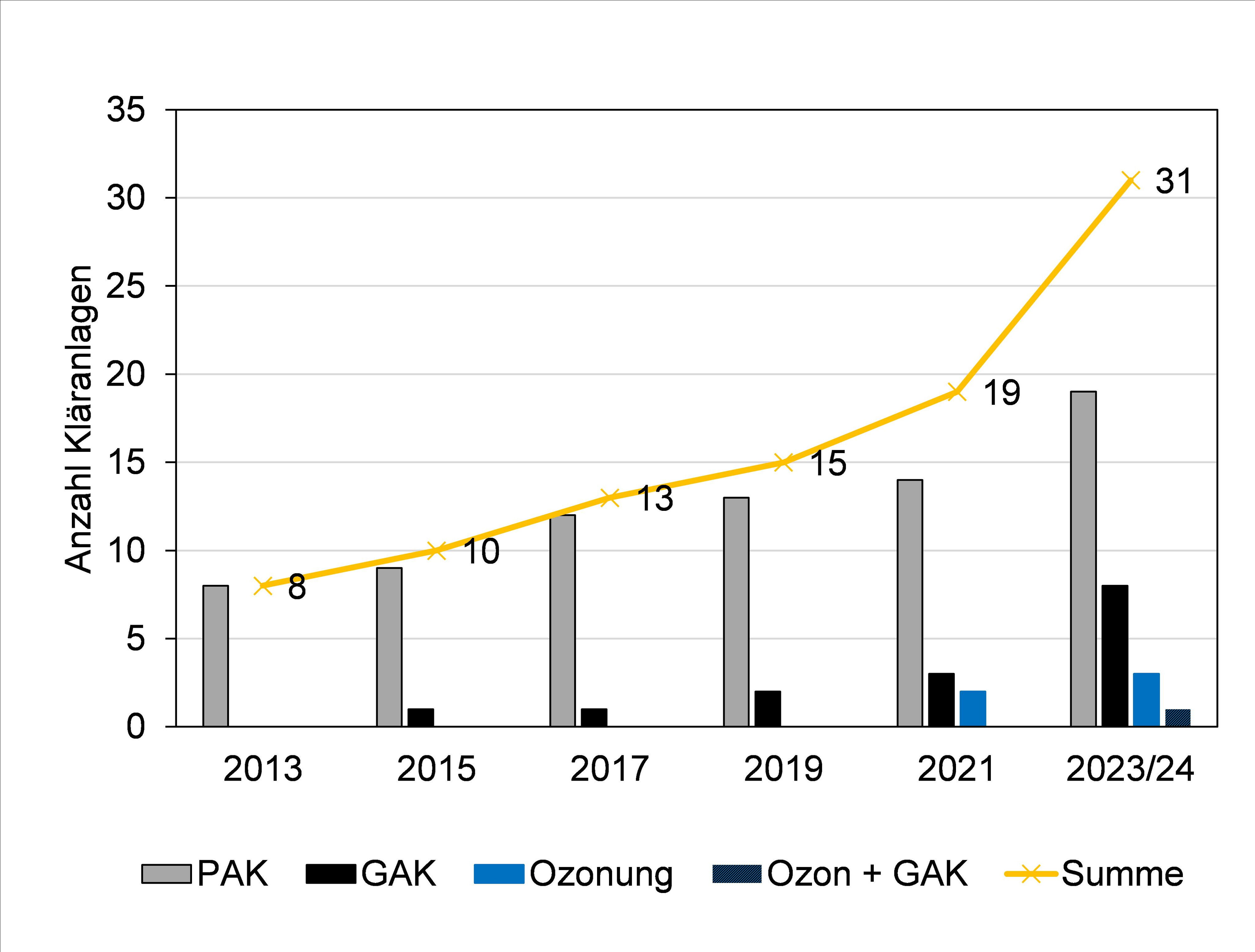
In Baden-Württemberg, powdered activated carbon processes were already used in the 1990s for the decolorization of textile wastewater. Within several research projects, this process was further developed and optimized for the removal of micropollutants from municipal wastewater. Due to the positive results and experience, and through significant joint efforts, the process was subsequently implemented at a large number of wastewater treatment plants in Baden-Württemberg.
As a result of extensive research activities, a growing diversification of treatment technologies began from 2016 onwards. In 2016, the first wastewater treatment plant was upgraded with a treatment stage for targeted micropollutant removal in the form of a granular activated carbon (GAC) adsorption system. In 2019, the first ozonation system at a municipal wastewater treatment plant in Baden-Württemberg was put into operation. Since the end of 2023, the first combined process of ozonation and GAC adsorption has been in operation.
In parallel with the first upgrades of wastewater treatment plants and to support plant operators, the Micropollutant Competence Centrer (KomS) Baden-Württemberg was established in April 2012. Since then, KomS has supported the implementation of micropollutant removal at municipal wastewater treatment plants, including through consulting services and research projects.
Network and partners
Currently, various institutions and organizations are working on the topic of micropollutant removal. In line with its mission of knowledge transfer and communication, KomS works closely with these organizations and maintains a regular exchange on new projects and current issues. The aim is to promote national and international knowledge sharing and to consolidate existing expertise.