Micropollutants
Micropollutants are substances found in wastewater in low concentrations ranging from a few nanograms to micrograms per liter. These include e.g. active pharmaceutical ingredients, pesticides, cosmetics, cleaning agents, and industrial chemicals.
Despite the widespread availability of advanced wastewater treatment plants, these substances enter water bodies, where they can have adverse effects on aquatic ecosystems and/or negatively impact the extraction of drinking water from raw water. However, with a process stage for the targeted elimination of micropollutants at municipal wastewater treatment plants (also known as the fourth treatment stage), these micropollutants can be removed to a large extent.
In the past, the Competence Centre for Micropollutant Removal Baden-Württemberg (KomS) has analyzed a total of 40 municipal wastewater treatment plants for the presence of a total of 50 different micropollutants in both influent and effluent. The results of this inventory are available on the website in the German final report entiteled „Bestandsaufnahme der Spurenstoffsituation von Kläranlagen in Baden-Württemberg” (translates to: Inventory of the micropollutants situation at wastewater treatment plants in Baden-Württemberg).
Inventory
The inventory showed that around half of the micropollutants analysed were detected in almost all wastewater treatment plant influents, indicating that micropollutants are widespread in municipal wastewater treatment plant inflows. Only five of the substances investigated could not be detected in any of the influents examined.
In the effluent of conventional municipal wastewater treatment plants, 40% of the micropollutants could still be quantified across the state. This demonstrates that conventional mechanical-biological wastewater treatment is not capable of removing a broad range of micropollutants from wastewater.
Comparative measurements
It is also possible to classify your own micropollutant concentrations using the German publication “Tabellenwerk zur Bewertung der Spurenstoffsituation” (KomS, 2021) (English translation: “Table for Assessing the Micropollutant Situation”).
The implementation of a dedicated micropollutant removal stage can significantly reduce micropollutant emissions from municipal wastewater treatment plants. Both adsorptive and oxidative processes can be used for this purpose (see: Technologies). To demonstrate the improvement in micropollutant removal achieved by upgrading municipal wastewater treatment plants with an adsorptive treatment stage, KomS conducted extensive comparative measurements between 2014 and 2018. The results are presented in the German report “Durchführung von Vergleichsmessungen zur Spurenstoffelimination beim Ausbau von Kläranlagen um eine 4. Reinigungsstufe” (English translation: “Conducting Comparative Measurements for Micropollutant Removal in the Expansion of Wastewater Treatment Plants with a Fourth Treatment Stage”).
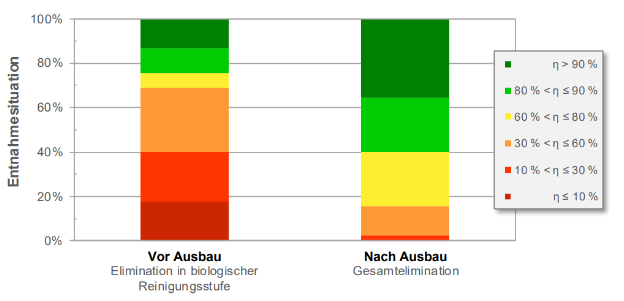
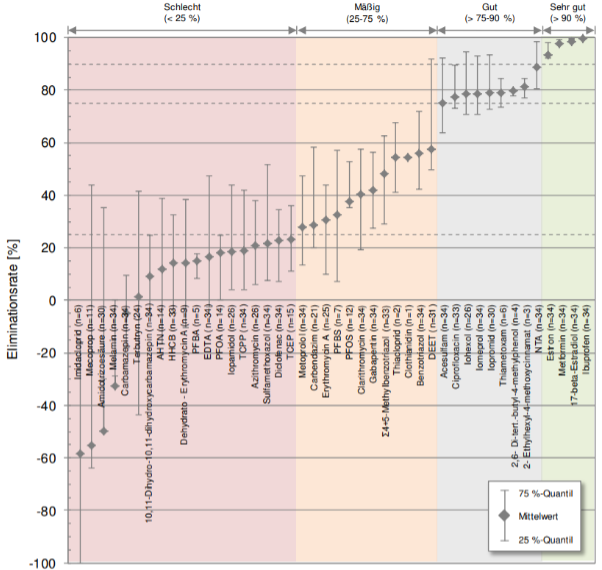
As part of these comparative measurements, a total of ten wastewater treatment plants equipped with a dedicated micropollutant removal stage were sampled before and after the upgrade. In total, 47 different micropollutants were analysed. The results showed that the removal of these micropollutants was significantly improved through the implementation of an adsorptive treatment stage. While 40% of the micropollutants were classified as difficult to remove before the upgrade, this proportion decreased to less than 5% after the upgrade (see figure).