Adsorptive Processes
In these processes, micropollutants are adsorbed onto the surface of a solid material (adsorbent). In municipal wastewater treatment plants, activated carbon is commonly used as the adsorbent.
Activated carbon is capable of adsorbing a broad range of substances compared to other adsorbent materials; however, it has a finite adsorption capacity. Once this capacity is exhausted, the activated carbon must be replaced and/or regenerated.
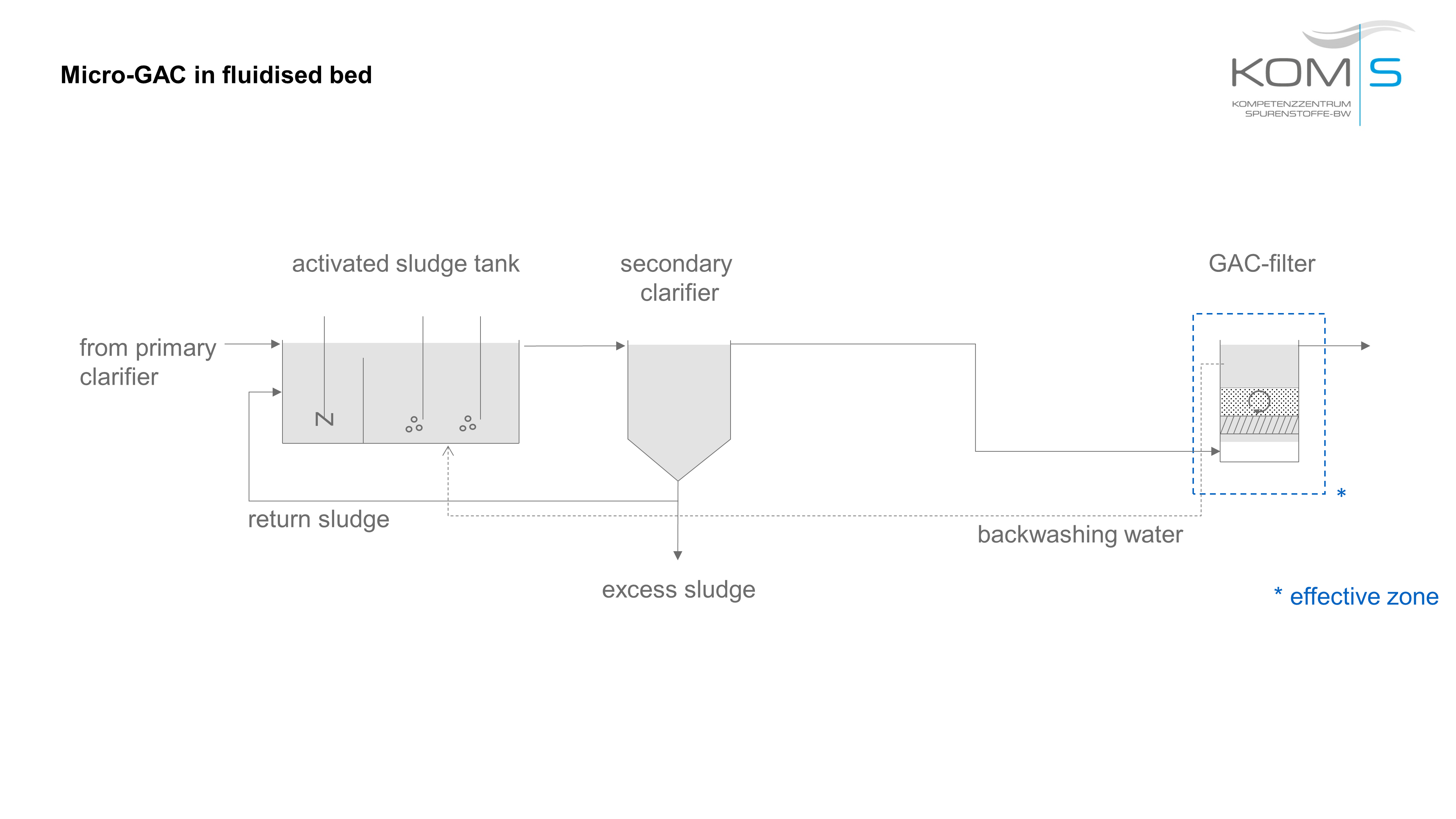
For the removal of micropollutants in municipal wastewater treatment, both powdered activated carbon (PAC) and granular activated carbon (GAC) can be applied. The process configuration of adsorptive wastewater treatment is primarily determined by the form of activated carbon used. Several process variants have already been investigated for both types of activated carbon. Another option for using activated carbon for micropollutant removal in municipal wastewater treatment plants is the application of micro-granular activated carbon (micro-GAC, particle size range 0.20–0.8 mm) in a fluidized bed.
Further information and details can be found in this publication.
Powdered Activated Carbon
Powdered activated carbon (PAC) consists of finely ground activated carbon. Commercially available PAC typically has a mean particle size ranging from 10 to 50 µm.
In wastewater treatment, PAC is added directly to the wastewater to be treated. Adsorption occurs during contact between the activated carbon and the wastewater, requiring thorough mixing to ensure effective mass transfer. As the contact times that can be achieved in practice are considerably shorter than those required to reach adsorption equilibrium, the PAC concentration is increased within the treatment process to maximize the utilization of its adsorption capacity. After a sufficient contact time, the powdered activated carbon must be separated from the treated wastewater.
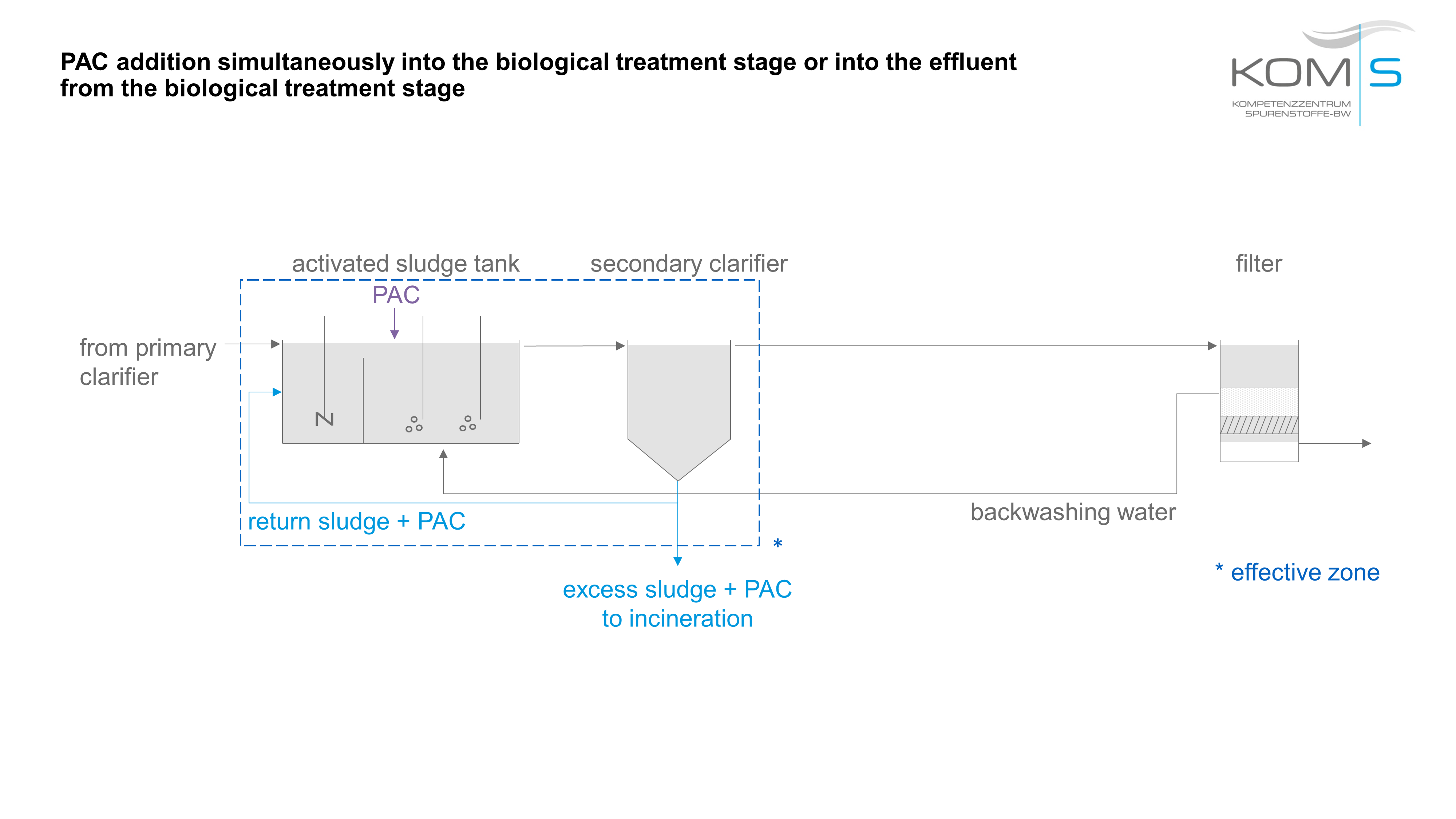
Simultaneous dosing into the biological treatment stage or into the effluent of the biological treatment stage.
If the retention of powdered activated carbon in the secondary clarifier is insufficient, a downstream filtration step is required.
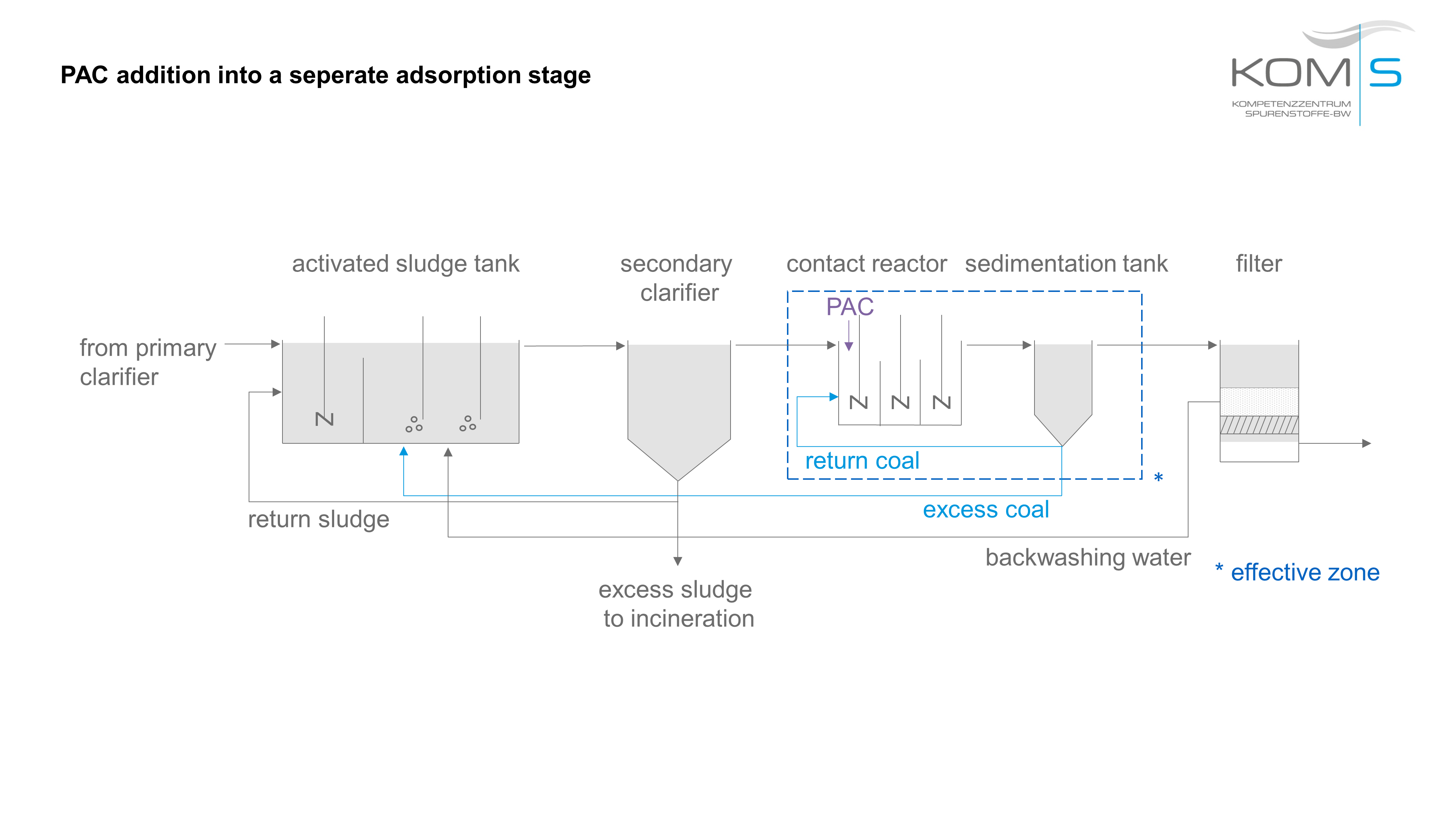
Dosing of activated carbon into a separate adsorption stage.
The adsorption stage is located downstream of the secondary clarifier and consists of a contact reactor and a sedimentation tank. Powdered activated carbon (PAC) is first added to the biologically treated wastewater in the contact reactor. In the subsequent sedimentation tank, the PAC is separated from the wastewater by the addition of metal salts and polymers.
To maximize the utilization of the activated carbon, the settled carbon sludge is recirculated to the contact reactor as return carbon. Excess carbon can be returned to the biological treatment stage to further utilize its remaining adsorption capacity. A downstream filter removes any powdered activated carbon that is not retained in the sedimentation tank from the treated wastewater.
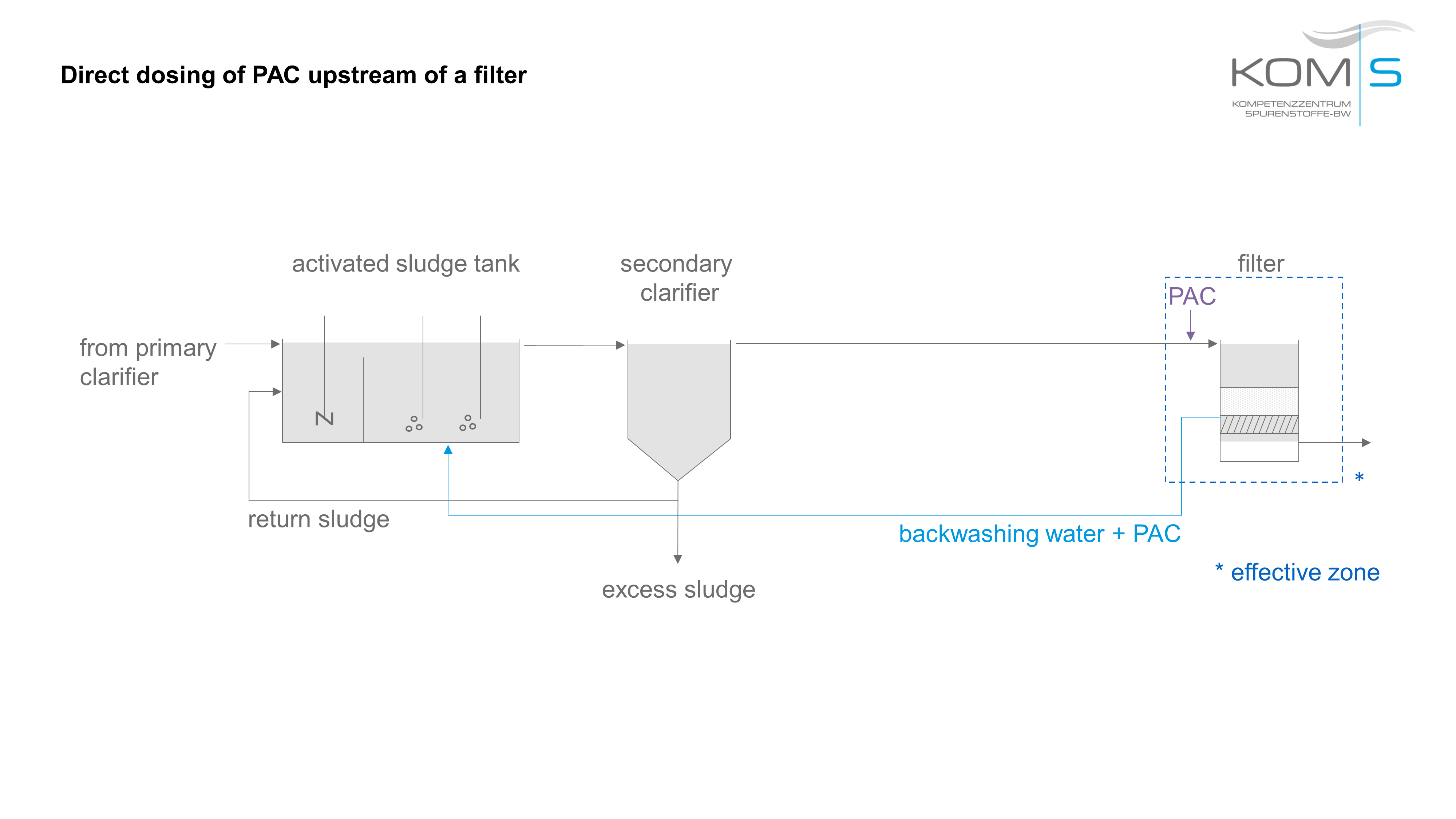
Direct dosing of powdered activated carbon upstream of a filter
Direct dosing of powdered activated carbon (PAC) upstream of a filter, or alternatively into a contact tank or the filter supernatant (see Figure 2). The carbon separated with the filter backwash water or supernatant can be returned to the biological treatment stage in order to fully utilize its adsorption capacity.
Granular Activated Carbon (GAC)
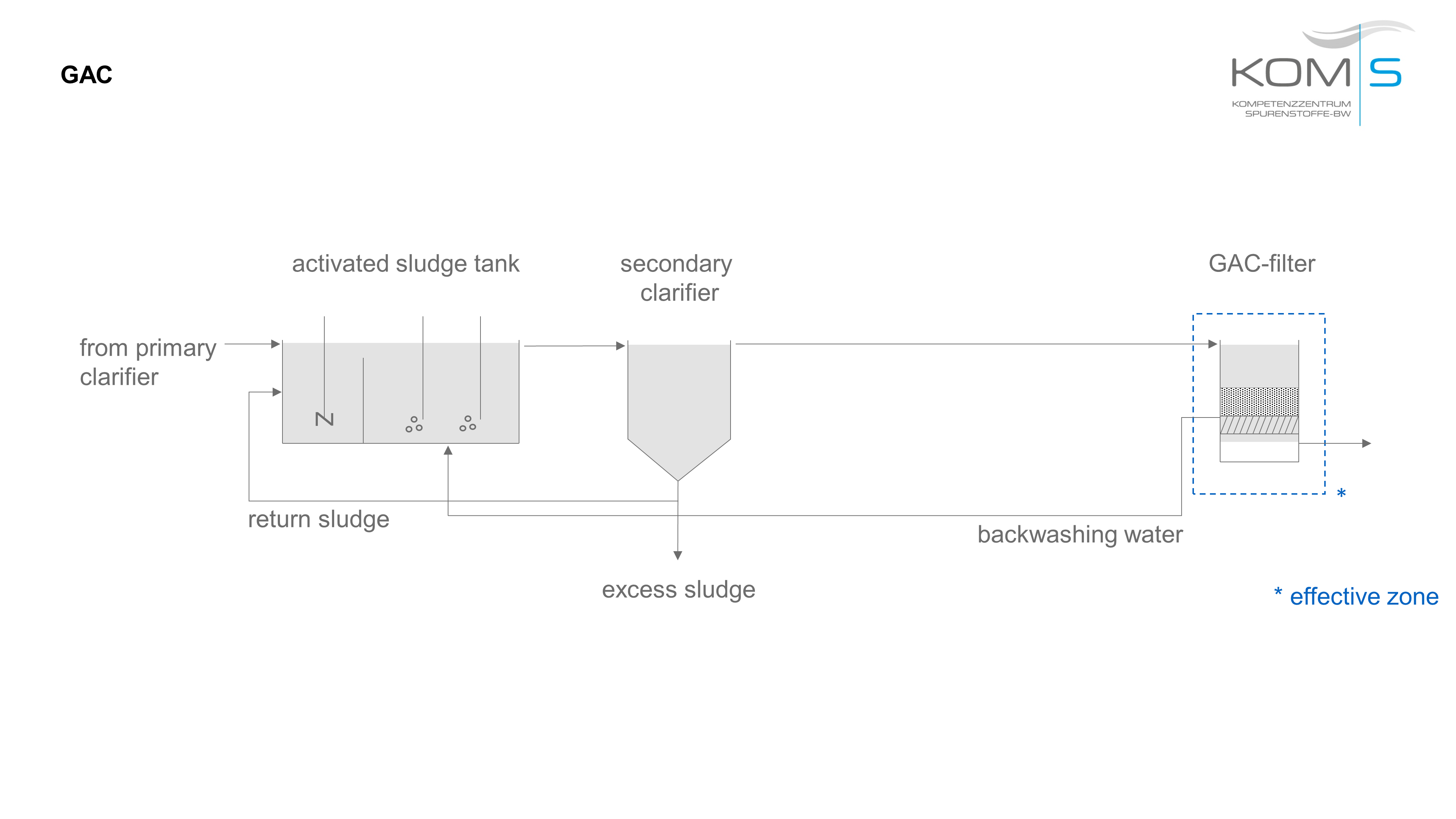
Granular activated carbon (GAC) typically has a particle size range of 0.5 to 4 mm. GAC is applied in fixed-bed adsorbers, where wastewater flows through a packed bed of carbon granules and micropollutants are adsorbed onto the activated carbon. No additional separation step is required downstream of the GAC stage. Once the adsorption capacity is exhausted, the activated carbon is removed and can be regenerated and subsequently reused for adsorption.
GAC is applied after the biological treatment stage. Both intermittently backwashed gravity filters, pressure filters, and continuously backwashed filters are used. If a gravity filter is already present at a municipal wastewater treatment plant, it can potentially be converted into an activated carbon filter by replacing the existing filter media with granular activated carbon.
In a GAC filter, not only micropollutants but also suspended solids can be retained. However, the accumulation of solids within the filter bed leads to increased head loss, which requires more frequent backwashing. The backwash water can be returned to the biological treatment stage. Alternatively, a GAC filter can be installed downstream of a conventional filter. In this configuration, suspended solids are removed prior to the GAC stage, ensuring that the carbon filter is operated with nearly solids-free wastewater. This reduces the frequency of backwashing.
micro-GAC in a fluidized bed
In the “micro-GAC in a fluidized bed” process, granular activated carbon (GAC) with a defined particle size range of 200–800 µm (micro-GAC) is kept in suspension in an upward-flow reactor. The wastewater to be treated is introduced evenly across the entire filter base. Above this inlet zone is the activated carbon bed. The activated carbon is maintained in a suspended state by the upward flow, forming a fluidized bed and an interface between the carbon and the water phase.
After contact with the expanded activated carbon, the treated effluent is collected via a network of evenly distributed effluent troughs at the top of the reactor. Controlled expansion of the micro-GAC ensures that no carbon particles leave the reactor and thus the wastewater treatment plant. Depending on the flow velocity and the type of activated carbon used, the bed expansion typically ranges between 20% and 100%. Suspended solids (SS) are partially retained within the fluidized bed, depending on particle size.
The fluidized bed can be cleaned by periodic washing with water or air. Fresh micro-GAC is added periodically (e.g. daily), while an equivalent amount of spent micro-GAC is also withdrawn on a regular basis.